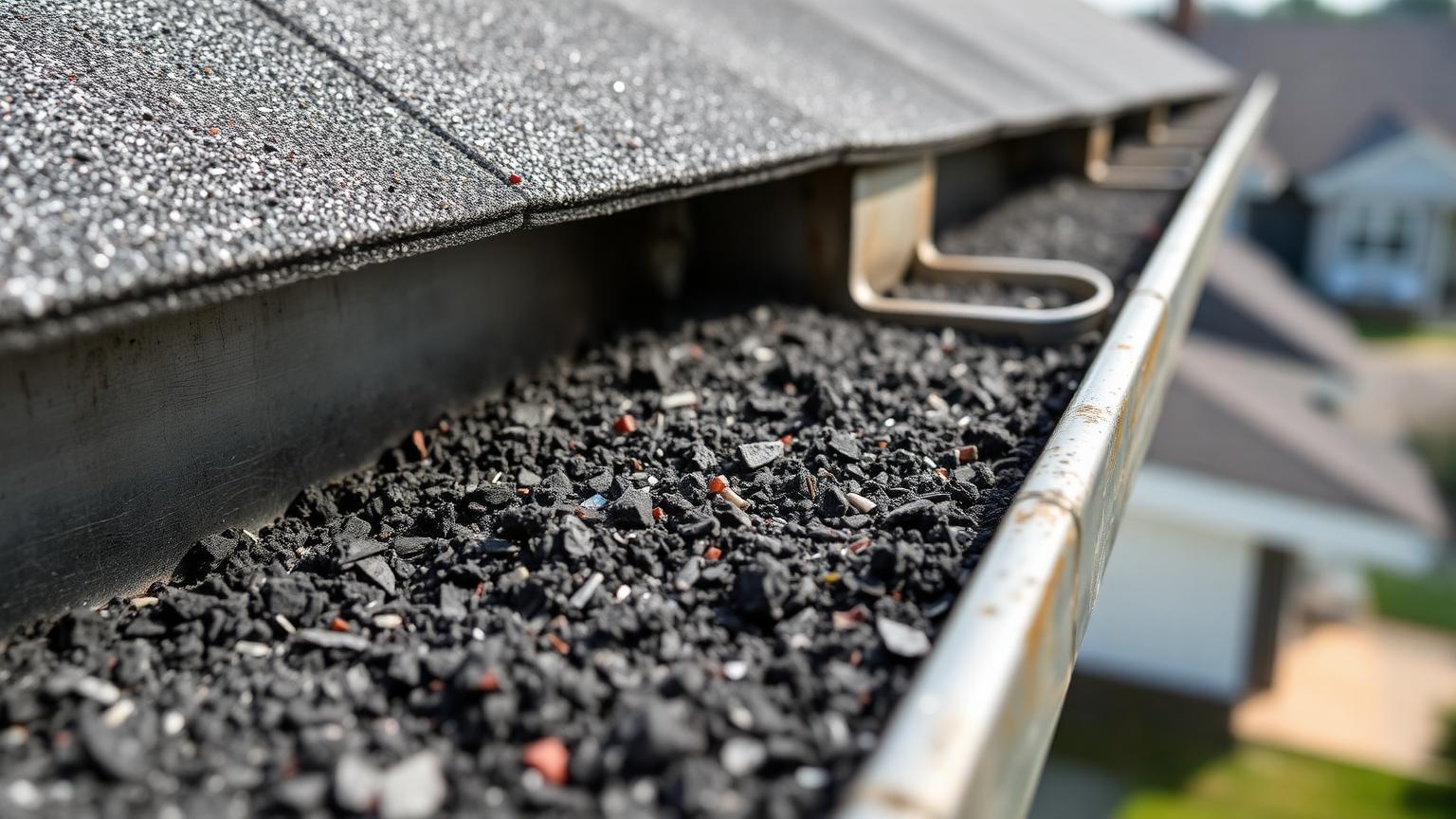
Seeing roof granules in gutters can be unsettling. But granule loss is often a timing clue, not an automatic sign your roof has "failed." Here's what granules do, why shingles shed them, and how to tell normal granule loss from aging that needs attention.
If you've cleaned your gutters and noticed gritty, sand-like material collecting near the downspouts, you're not alone. Homeowners frequently discover asphalt shingle granules in gutters and assume the roof is falling apart. The reaction makes sense: if pieces are coming off the roof, the roof must be failing, right?
In reality, granules in gutters can mean several different things depending on timing, volume, and what's happening on the roof surface. Some granule loss is expected. Some granule loss is a sign of normal aging. And in certain situations, granule loss can reveal a deeper issue like accelerated wear, brittle shingles, poor drainage patterns, or storm-related damage. The key is learning how to interpret granules as information, rather than treating them like an emergency alarm every time you see them.

What asphalt shingle granules do (and why they exist)
Asphalt shingles are not just "flat pieces of tar." They're a layered product. Under the surface granules is an asphalt coating designed to help shed water, and beneath that is a base mat (commonly fiberglass in modern shingles) that provides structure and tear resistance. The granules are the roof's outer protective layer, think of them as a wearable surface meant to take the abuse so the asphalt below doesn't have to.
Granules serve several important functions:
- •UV protection: Sunlight breaks down asphalt over time. Granules shield the asphalt from direct ultraviolet exposure, slowing aging.
- •Impact resistance: Granules help the shingle surface handle minor impacts from wind-blown debris and light hail.
- •Fire performance: Many shingle systems rely on granules to improve fire resistance.
- •Durability and traction: Granules toughen the surface and reduce slickness compared to exposed asphalt.
- •Color and heat reflection: Granules provide the visible color and can influence how much heat the roof absorbs.
This matters because when granules are lost, the asphalt underneath becomes more exposed to sun, temperature cycling, and abrasion. That doesn't mean the roof leaks the moment granules appear in the gutters. It means the surface protection is being consumed, like tread wearing down on a tire. The tire can still function, but the "wear indicator" is worth paying attention to. Granules aren't just "roof sand", they're a core protective layer that helps shield asphalt from UV breakdown and weathering. If you want a clear manufacturer-level explanation of how shingles are built and why granules matter, this overview from the Asphalt Roofing Manufacturers Association is a solid reference: A Simple Guide to Understanding Your Asphalt Shingle Roofing System.
Why shingles shed granules in the first place
Granule shedding happens for different reasons across the life of a roof. Understanding the "why" helps you interpret the "how worried should I be?" question.
1) New roof shedding (often normal)
Many roofs shed some loose granules soon after installation. During manufacturing, shipping, stacking, and installation, shingles rub and vibrate. Some granules that were not fully embedded can dislodge early. If your roof is new and you see granules in downspouts after the first few storms, that can be totally normal, especially if it decreases over time.
2) Weather and thermal cycling (gradual wear)
Roofs heat up during the day and cool down at night. Over years, this expansion and contraction can weaken how granules adhere. Rain then acts like a conveyor belt: loosened granules wash downhill and collect where water slows, often in the gutters and downspouts.
3) Storm-related granule loss (event-driven)
A sudden increase in granules after a storm can be a sign of impact or abrasion. Wind-driven debris, hail, and heavy rain can all dislodge granules. One important detail: a storm can cause granule loss without causing an immediate leak. Granules may indicate surface damage that affects lifespan, not instant waterproofing failure.
4) Foot traffic and "service scuffing"
When people walk on shingles, contractors servicing HVAC equipment, installing satellite mounts, cleaning gutters from the roof edge, granules can scuff off. This scuffing is often concentrated near common walking paths: around penetrations, along valleys, near the ridge, and at roof access points.
5) Aggressive cleaning methods
Pressure washing or harsh brushing can strip granules quickly. If granules suddenly show up in large volume after cleaning, the gutters may be revealing that the roof surface was mechanically worn rather than naturally aged.
Normal granule loss vs. granule loss that signals deeper aging
Homeowners usually don't need a microscope. You need pattern recognition. Here are the differences that matter most when evaluating shingle granule loss.

Normal or expected granule loss often looks like:
- •Light, intermittent granule presence, especially after heavy rain
- •Some granules during the first season after installation
- •Granules concentrated near one downspout because of how water channels through that gutter run
- •No visible bald patches on shingles when viewed from the ground
- •No change over time (similar small amount each cleaning cycle)
Granule loss that can signal aging or accelerated wear often looks like:
- •Noticeably increasing granule volume each time gutters are cleaned
- •Multiple downspouts collecting significant grit (not just one "collection point")
- •Shingles appearing patchy or "washed out" from the ground
- •Dark asphalt showing through in spots (bald areas)
- •Granule loss concentrated in valleys, below roof features, or on sun-baked slopes
- •Other aging signs nearby: lifted edges, brittle appearance, frequent small debris accumulation
A simple way to think about it: granules in gutters are a symptom, not a diagnosis. They are evidence that the roof surface is shedding, but the cause could range from "normal settling" to "wear acceleration."
Why granules in gutters are a timing indicator, not an immediate failure sign
Homeowners often hear the word "granule loss" and imagine the roof suddenly becoming porous. But roofs are systems. Shingles overlap, underlayment exists beneath, and water generally has to pass through multiple opportunities to be redirected back out. That's why many roofs can shed granules for years and still keep water out, until they reach a point where surface wear and detail vulnerabilities overlap.
Granules are best understood as a timing indicator. They can help you answer:
- •Is the roof still in early life, mid life, or late life behavior?
- •Did something happen recently that accelerated surface wear?
- •Is shedding stable, or trending upward?
- •Are the "busy areas" (valleys, penetrations, edges) losing protection faster?
This is why two homeowners can both see granules in gutters, yet one roof may be fine for years while the other is entering a vulnerable stage. The granules alone are not the verdict. The trend and context are the verdict.
How to use gutters as a practical roof "signal check"
You don't need to climb on the roof to use granule information. Gutters are like a collection tray that gathers what the roof sheds. If you want a homeowner-friendly approach:
- •Check timing: Did the granules appear after a storm, after cleaning, or after seasonal temperature swings?
- •Check volume: Is it a light dusting or a thick layer of grit near the downspout?
- •Check consistency: Is it the same every time, or increasing noticeably?
- •Check distribution: One downspout or all of them?
- •Check roof visuals from the ground: Any patchy texture changes, bald areas, or irregular zones?
How Granules in Gutters Relate to Roof Age and Remaining Life
One of the most useful ways to interpret granules in gutters is by looking at them through the lens of roof age. Asphalt shingle granules shed differently depending on where a roof is in its lifecycle, and understanding that context prevents overreaction or false reassurance.
In early roof life, granules in gutters are often the result of manufacturing and installation friction. These asphalt shingle granules were loosely embedded and dislodge during the first few rain events. In this stage, shedding typically decreases over time rather than increasing.
In mid-life roofs, granule loss tends to be gradual and seasonal. Thermal expansion, contraction, and rain slowly loosen surface granules. Gutters may collect small amounts intermittently, especially after heavy rain or temperature swings. This stage reflects normal wear rather than failure.
Late-life roofs behave differently. Granules in gutters begin to increase more noticeably and consistently. This happens because the asphalt beneath is drying and hardening, losing flexibility. As shingles become more brittle, asphalt shingle granules detach more easily under rain, wind, and minor impacts.
What matters most is the trend, not the presence alone. A roof that sheds a similar small amount year after year is aging predictably. A roof that sheds noticeably more granules each season is signaling accelerated surface wear.
This distinction is important because asphalt shingles rarely fail all at once. They transition through stages. Granules in gutters help reveal which stage the roof is currently in and how quickly it may be approaching vulnerability.
Rather than asking, "Is my roof bad?" a better question is, "Is my roof shedding at a stable rate, or is the rate increasing?" That shift in thinking turns granules into planning information instead of anxiety triggers.
Why Granules in Gutters Often Appear After Roof Work or Maintenance
Homeowners are often alarmed when granules in gutters appear shortly after roof related work. This timing can feel suspicious, but it does not always indicate damage or poor workmanship.
Any activity that disturbs shingles can dislodge loose asphalt shingle granules. This includes:
- •Gutter cleaning performed from the roof edge
- •HVAC or satellite service requiring roof access
- •Chimney inspections or flashing repairs
- •Tree trimming where debris contacts shingles
These activities can scuff the shingle surface, especially on older roofs where granule adhesion is already reduced. The gutters then act as a collection point, making the granule loss highly visible.
In these cases, granules in gutters do not necessarily indicate new roof damage. They often reveal granules that were already loose due to age or weathering and were simply knocked free.
The key difference is scope. Maintenance-related shedding is usually localized. Granules may appear after the work, then stabilize. Widespread or increasing granule accumulation long after work is complete suggests underlying aging rather than isolated disturbance.
This is why context matters. The timing of granules in gutters should always be compared to recent activity on or near the roof. Without that context, homeowners may assume a problem where none exists or miss a broader trend that deserves attention.
Understanding this relationship helps homeowners ask better questions and avoid unnecessary worry after routine maintenance.

When Granules in Gutters Combine With Other Warning Signs
Granules in gutters become far more meaningful when they appear alongside other indicators of roof aging. Asphalt shingle granules rarely tell the full story on their own, but they add important context when combined with surface and performance clues.
Homeowners should pay closer attention when granules in gutters occur together with:
- •Shingles that look thin, uneven, or patchy from the ground
- •Dark asphalt showing through in localized areas
- •Edges that appear curled, lifted, or brittle
- •Repeated debris accumulation in the same gutter sections
- •Minor leaks or moisture appearing after storms
These combinations suggest that asphalt shingle granules are no longer shedding evenly or predictably. Instead, they may be wearing away faster in high-stress zones such as valleys, sun-exposed slopes, or areas with frequent foot traffic.
At this stage, granules in gutters are no longer just a timing clue. They become an early warning that surface protection is thinning in places where water movement is concentrated.
This does not mean immediate failure is inevitable. Many roofs continue to perform for years after granule loss begins. However, it does mean that the margin for error is shrinking. Small defects, flashing weaknesses, or storm impacts are more likely to turn into leaks when granule protection is reduced.
The value of noticing this combination early is choice. Homeowners gain time to plan inspections, budget intelligently, and address vulnerabilities before damage escalates.
Granules in gutters paired with other aging signals are not an emergency alarm. They are a strategic signal that the roof is entering a more sensitive phase of its lifespan.

Frequently asked questions (FAQ)
Are granules in gutters normal?
Often, yes, especially after installation, storms, or seasonal weather changes. The important factor is whether the amount is stable or increasing over time.
Do granules in gutters mean my roof is leaking?
Not necessarily. Granules indicate surface shedding. Leaks depend on whether water is finding a pathway through vulnerable details like flashing, penetrations, valleys, or compromised shingles.
How long can a roof last after granule loss starts?
There isn't a single number. Granule loss can be a normal slow process for years. What matters is whether the roof shows bald patches, brittleness, repeated localized damage, or increasing granule accumulation.
Takeaway: *Asphalt shingle granules in gutters* are best treated as information. Some granule loss is normal. Increasing, widespread loss, especially paired with visible thinning, suggests the roof is aging into a more vulnerable stage. It's a timing clue, not an automatic "roof failure" diagnosis.
Final Thoughts
Finding granules in gutters does not automatically mean a roof is failing. In most cases, those granules are telling a story about timing, surface wear, and how the roof is responding to weather, age, and use. Asphalt shingle granules are designed to wear gradually, and some shedding is expected throughout the life of a roof.
The key is interpretation. Light, stable granule loss often reflects normal aging, while increasing or widespread granules in gutters can signal that surface protection is thinning in higher-stress areas. When viewed in context with roof age, recent storms, maintenance activity, and visible shingle condition, granules become useful information rather than a source of panic.
Homeowners do not need to react urgently every time granules appear. They do benefit from understanding trends, patterns, and what those changes mean for long-term planning. Granules are best treated as an early awareness signal, not an automatic failure diagnosis.
If you are unsure what the granules in your gutters are indicating, or if you want help understanding how asphalt shingle granules relate to your roof's remaining lifespan, a professional perspective can provide clarity. A calm evaluation often answers questions before they turn into stress.
Homeowners who want to discuss what they are seeing, ask questions, or get guidance on next steps can reach out through the Action Exteriors estimate page. Understanding comes first, and informed decisions follow.